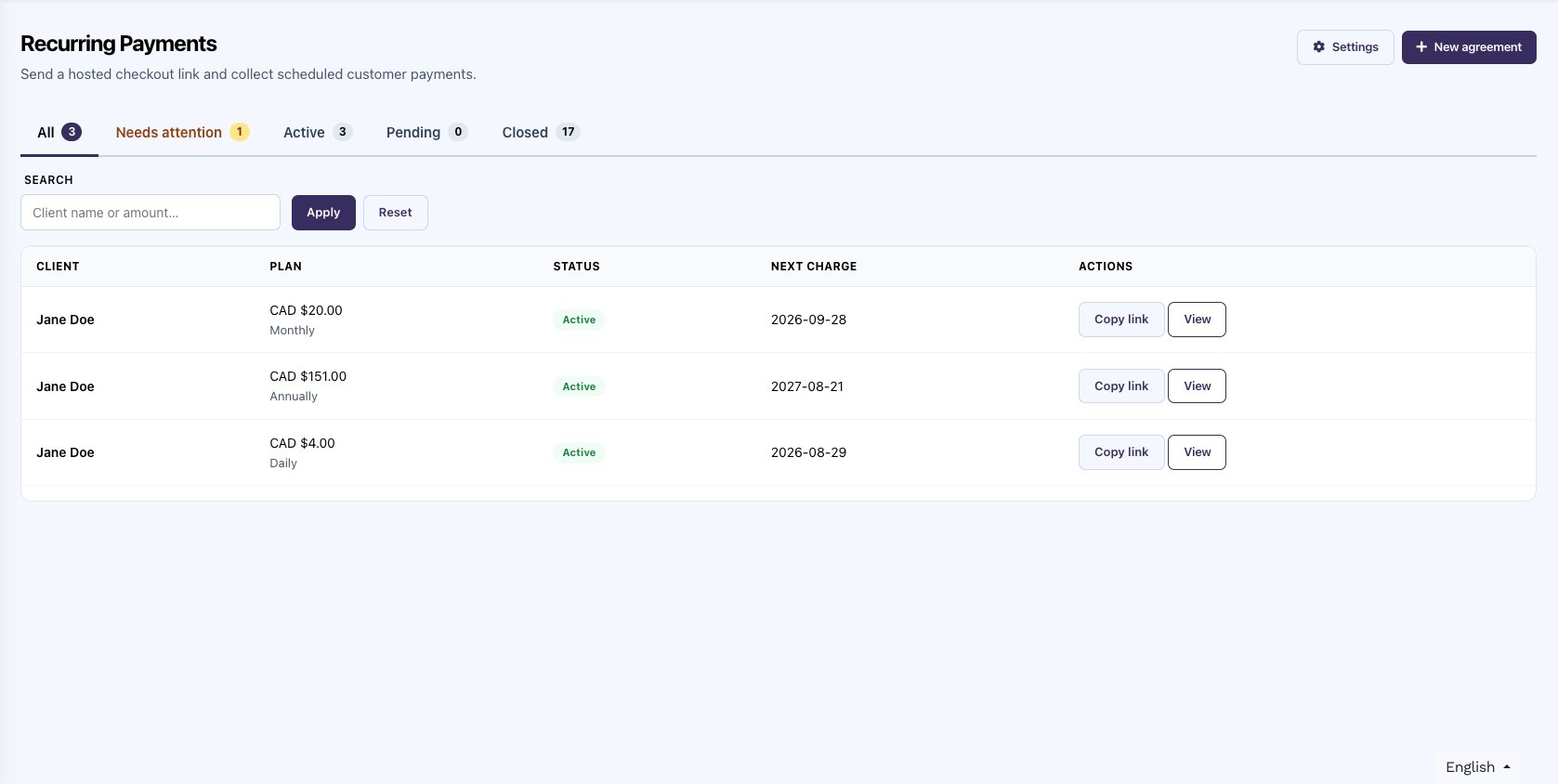
The Recurring Payments list with status tabs, client search, and agreement rows.
Prerequisites
1
Recurring Payments enabled
The Recurring Payments feature must be enabled on the entity plan. Enabling it also turns on Hosted Payment Solution and Clients. Ask your ISO admin to enable it in Plans & Features if you do not see Recurring Payments in the sidebar.
2
Elavon Converge on a location
At least one location must have an active Elavon Converge online payment gateway. Locations on other processors stay available for everything else. See Locations.
3
Client with an email
Each agreement needs a client with a valid email so Taliup can send the checkout invitation.
How it works
- If the first charge is today and there is no trial, checkout charges that cycle and starts the schedule.
- If the first charge is later, or you offer a free trial, checkout saves the card only. Charging starts on the first-charge date.
- Later cycles are collected by Converge. Taliup HQ syncs status, next date, and charge history.
Agreements list
When you have no agreements yet, the page shows No recurring agreements yet and Create your first agreement. Use + New agreement once Converge is available. Use Settings for defaults that apply to new agreements. Tabs:
Search by client name, email, or amount (
100 or $100), then Apply. Newest agreements appear first. Reset clears the search and keeps the tab you are on.
Click a row to open the agreement. Copy link copies the checkout link (pending) or the customer manage link (enrolled).
If anything needs a click, the list opens on Needs attention.
Create an agreement
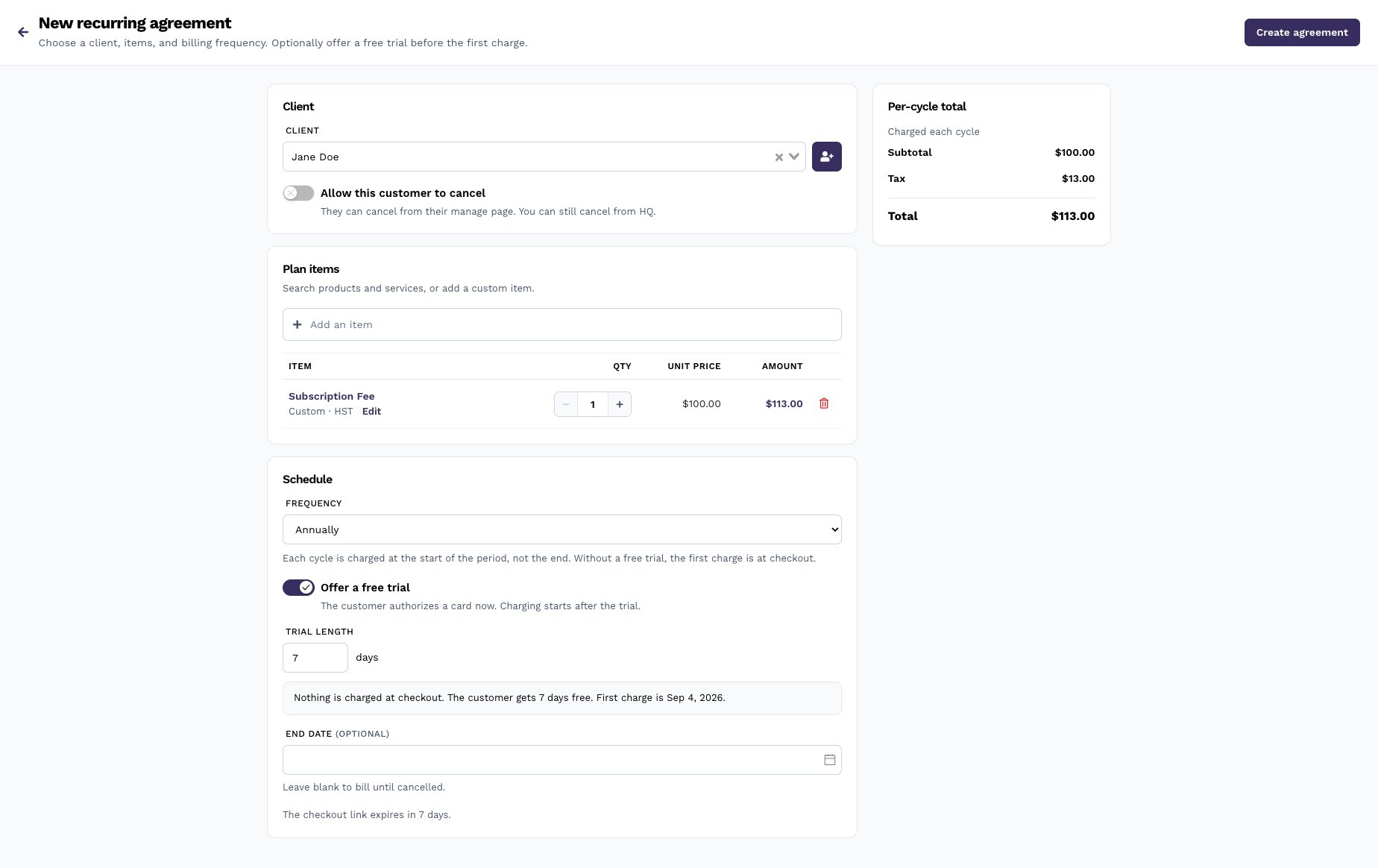
The New recurring agreement form with client, plan items, schedule, and per-cycle total.
1
Open New agreement
From Recurring Payments, click + New agreement.
2
Choose the client and location
Search for a client or use the person-plus button to add one. If that email belongs to a deleted client, Taliup asks Restore previous client? See Restore a deleted client.
3
Add plan items
Search products and services, or Add custom item. Set quantity and options. Taxes follow the selected location.
4
Set the schedule
Choose frequency, then set the first charge or offer a free trial. Optionally add an end date.
5
Create agreement
Confirm the Per-cycle total, then click Create agreement. Taliup emails the checkout link to the client.
Client
Plan items
Search the catalog or add a one-off custom item. Catalog items with options open the options picker. Custom items can have their own taxes. You cannot change catalog items or the schedule after the agreement is created. Create a new agreement if the plan needs to change.Schedule
The checkout link expiry (default 7 days) is shown on this form. Change it in Settings.
Per-cycle total
The sidebar shows subtotal, tax, and total for each billing cycle. This is the amount Converge charges after enrollment (and at checkout when the first charge is today and there is no trial).After you create
The agreement starts as Pending.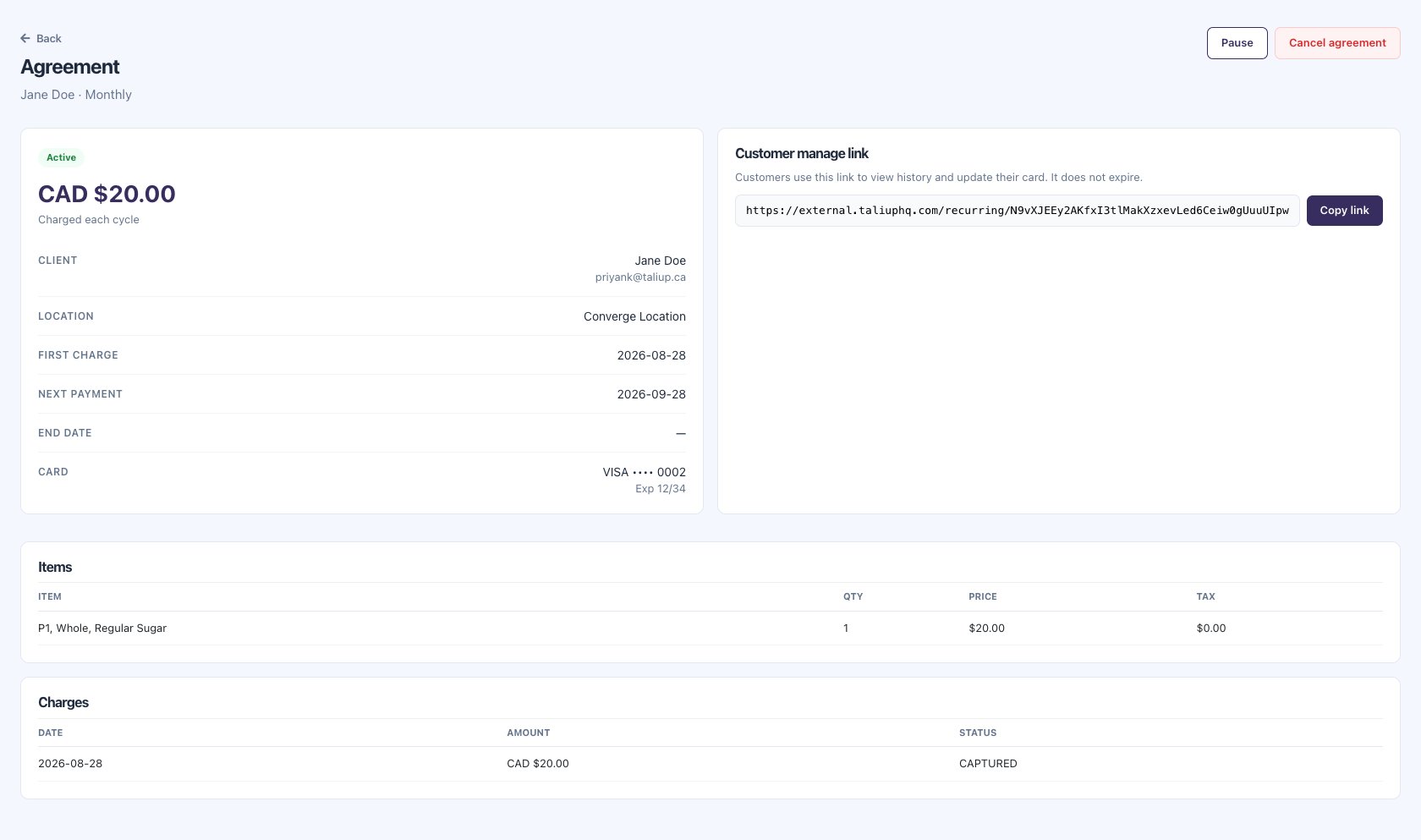
The Agreement page with status, first charge, card, customer manage link, items, and charges.
The checkout link expires after the invitation window and can be used once. An expired link cannot be resent. Create a new agreement if the customer still needs to enroll.
After checkout:
- A charge appears under Charges when the first charge is today. If the first charge is later, or this is a free trial, the card is saved and nothing is charged yet.
- Status moves to Active.
- The Customer manage link appears. It does not expire. Customers use it to see history, update their card, and cancel if you allowed it.
Statuses
Charge now
Charge now appears only on Past due or Grace period agreements that already have a Converge schedule. It collects one missed payment today. It does not wait for the next scheduled date. It is not available on Active.1
Open the agreement
Open a Past due or Grace period agreement.
2
Charge now
Click Charge now. Confirm the amount and the card last four.
3
Skip the next scheduled charge
The switch Skip the next scheduled charge on is on by default when that date is today or tomorrow. Leave it on if you do not want Converge to charge again on that date. Turn it off if you still want the regular cycle to run.
When a charge declines
A red banner on the agreement reads The latest charge was declined. It can include the processor response. Taliup emails you and the customer. The customer can open the manage link and click Update payment method. Updating the card does not collect the missed payment by itself.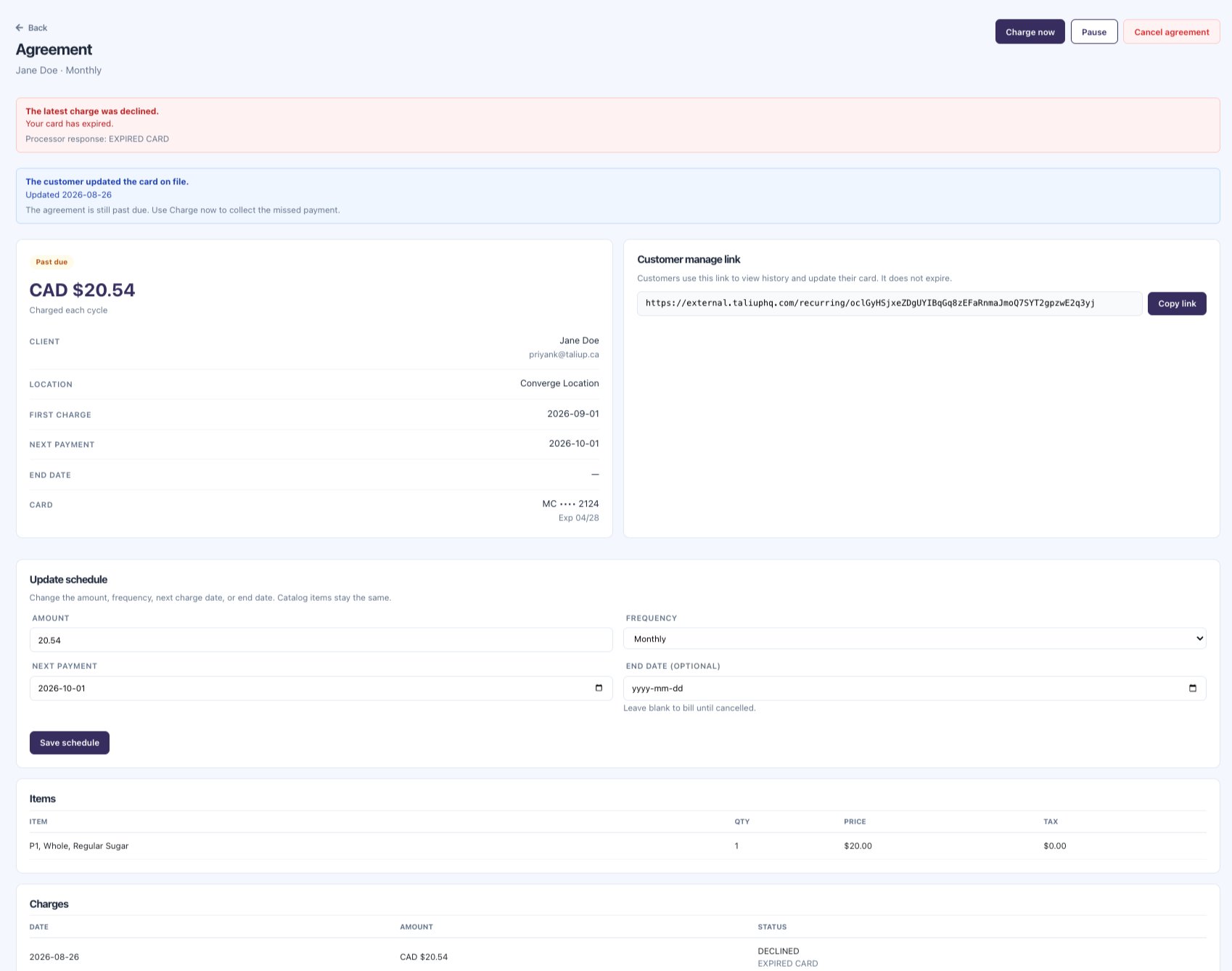
A past-due agreement after the customer updated the card. Charge now is available.
- Status is Active again, or
- A successful charge is collected at or after the card update (Charge now or the next scheduled sale)
Pause, resume, and cancel
Customers can cancel from the manage page only when Allow this customer to cancel is on for that agreement. They confirm in a sheet, then the page shows who cancelled.
You cannot change the amount, frequency, or dates after enrollment. That needs a new customer authorization. Create a new agreement if the plan must change.
Settings
From the Recurring Payments list, click Settings.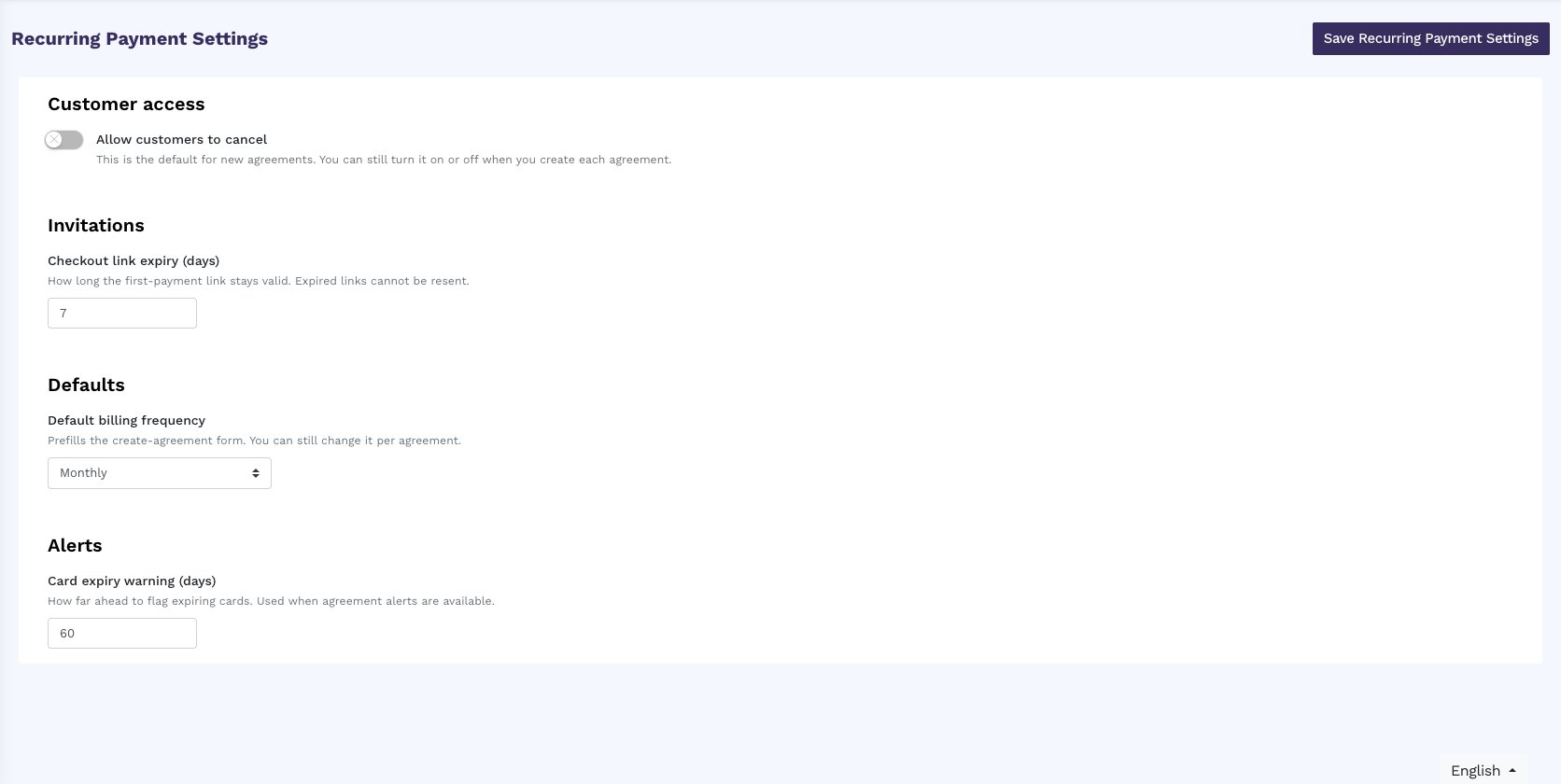
Recurring Payment Settings for customer access, invitations, defaults, and alerts.
Click Save Recurring Payment Settings.
What customers see
Customers do not log in to Taliup HQ.- Checkout link — one-time page to pay today, or to save a card when the first charge is later or a trial is on. The page follows the entity language. Customers can switch to English, French, or Mexican Spanish. They must check I authorize to charge my card…
- Customer manage link — does not expire. Customers can view the schedule, charge history, and Update payment method. Cancel recurring payment appears only if you allowed it. They confirm in a sheet, then can go back. The page uses the same language dropdown.
Emails
Ask the customer to check junk if an invitation is missing. Confirm the client email on the agreement before you resend.
Troubleshooting
Recurring Payments is not in the sidebar
Ask your ISO to enable Recurring Payments on the entity plan. It requires Hosted Payment Solution and Clients.You cannot create an agreement
Add an active Elavon Converge gateway to at least one location.Customer did not get the checkout email
- Confirm the client email on the agreement.
- Ask them to check junk.
- Use Resend email if the link is still valid, or Copy link and send it yourself.
- If the link expired, create a new agreement.